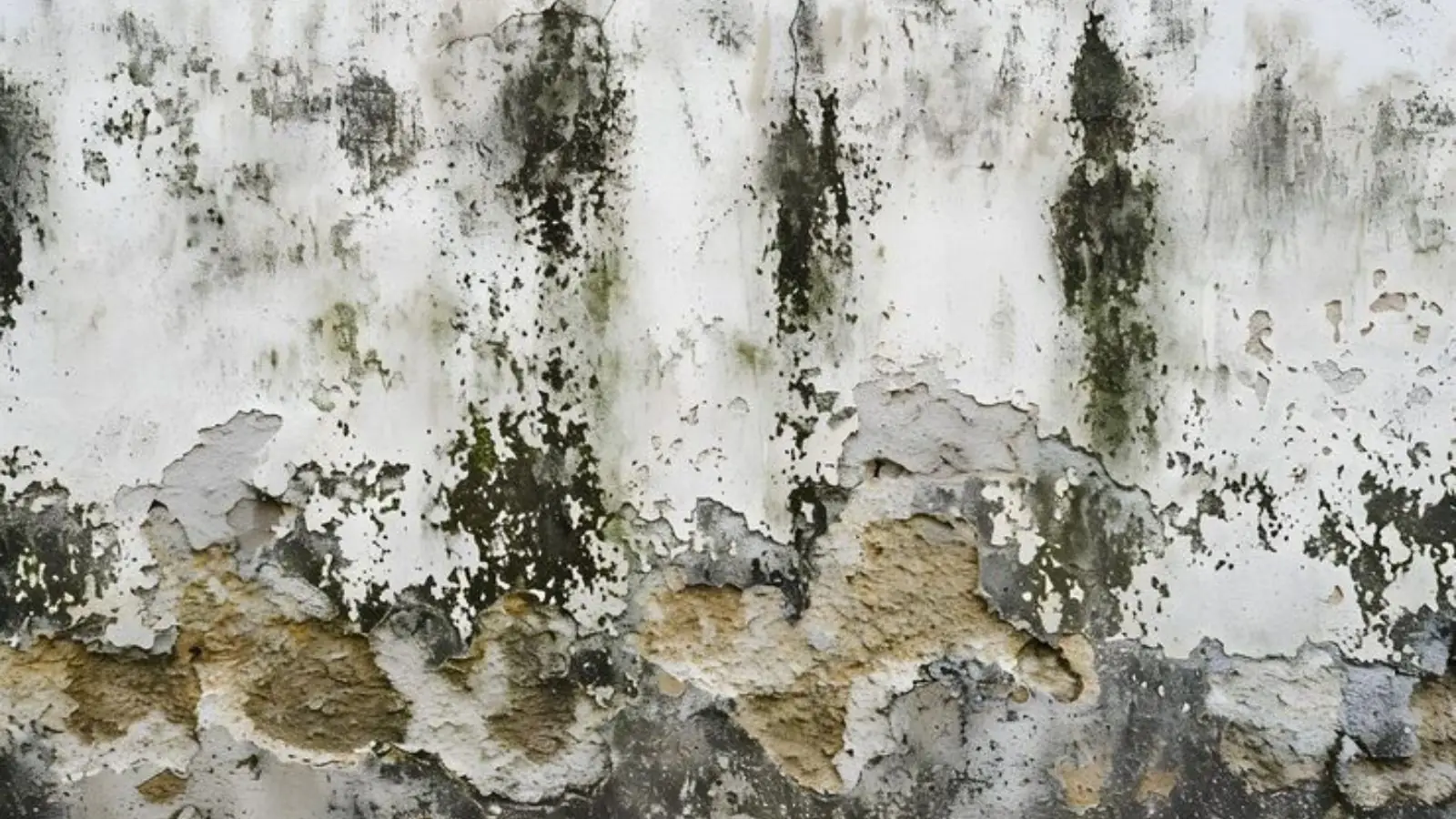
What does black mold look like to the eye?
People usually describe it as dark green, black or deep gray spotting, sometimes fuzzy, sometimes flat and smudged. It often appears in patches that grow outward from a damp area, with a fringe that looks uneven rather than neat.
That description fits a lot of other things too, which is why this question has no one-look answer. The honest answer to what black mold looks like is: sometimes like this, sometimes like dirt, and often only a lab or a trained inspector can say.
Things that look like mold but are not
Plenty of dark marks on walls and ceilings are not growth at all. Soot, dust and cobwebs collect along cold edges. Ghosting is a dark outline that forms where framing sits behind drywall and the surface runs colder. Water stains, rust bleed from nails and cooking residue can all look convincing from across the room.
| It may be | How it often looks | Quick clue |
|---|---|---|
| Dirt or soot | Gray-black film, often near vents or candles | Wipes away dry or with a damp cloth |
| Mildew | Flat, powdery gray or white on damp surfaces | Often on bathroom grout or window sills |
| Water stain | Tan or brown ring with a defined edge | Looks the same color all through and does not spread fuzzy |
| Ghosting | Dark stripes matching studs or nails | Pattern follows the framing |
| Possible mold | Dark spotting, can be fuzzy or smeared | Near moisture, smell, or grows over time |
The clues in the third column are hints, not a diagnosis. A wipe test can be misleading, because mold can also wipe away and leave stained material behind.
Where it hides
Mold favors places that stay damp and still: behind furniture pushed against an exterior wall, under sinks, around window frames, inside closets, on the back of drywall in a bathroom, and in crawl spaces. Basement corners with poor air movement are common spots. Attic sheathing can show growth when warm indoor air condenses against a cold roof deck.
Look for the combination of a dark patch and a moisture source. Without a water source nearby, a dark mark is more likely dirt or staining.
Why color alone cannot identify it
Mold comes in many colors, including white, green, gray, brown, orange and black. The popular label black mold covers a color description, not one fixed identity, and plenty of molds look dark. Color can change with the surface, the age of growth and the lighting.
No honest inspector names a type from a photo. Identification takes sampling and lab work, and even then, the scope of remediation depends on moisture and how much material is affected, not on a name.
No health claims here
We cannot tell you what a dark patch means for anyone's health. Mold needs moisture, remediation and testing follow ANSI/IICRC S520, and questions about symptoms belong to a physician.
Looking at a dark patch and wondering about next steps? Call (303) 952-8295 and a dispatcher will explain what scoping involves and what it costs before any work starts.
Call (303) 952-8295Testing options
Options range from a visual inspection with moisture readings to surface tape lifts and air samples sent to a lab. Each answers a narrow question, and none is a complete answer alone. Air samples vary by day and conditions, so a result is a snapshot rather than a verdict.
A thoughtful inspector begins with moisture mapping, because finding the wet material often explains more than a lab report. Whether you test, ask who performs the sampling, and what standard they follow.
- Visual inspection with a moisture meter and thermal camera
- Tape or swab surface samples for lab review
- Air sampling compared with an outdoor sample
- Post-remediation clearance by an independent party
What to do while you decide
Keep the area dry and ventilated, fix any obvious leak, and avoid scrubbing or sanding the patch. Disturbing it can spread material to clean rooms. Take dated photos so you can see whether it changes.
If the dark patch followed a leak or flood, our mold remediation and flood damage restoration teams can scope both problems together.
Littleton, CO: snow, creeks and floodplains
NWS Boulder lists Denver's normal seasonal snowfall at 49.0 inches, and says western and southwestern Denver suburbs average about 65 to 70 inches of snow per season. These are metro area numbers, not Littleton readings. Heavy snow that melts against a foundation or roofline is a moisture source, so check basement corners, attic edges and window wells each spring.
Littleton has FEMA floodplains and local floodplains, regulated the same way, and the 1978 FEMA Flood Insurance Study lists Big Dry Creek, Lee Gulch and Slaughterhouse Gulch as flooding sources. If your property sits near one of those drainages, ask the city's floodplain administrator in Public Works and Engineering at 303-795-3863 about your lot before you plan any work.
Sources: NWS Boulder annual summary and seasonal snowfall pages, City of Littleton floodplain pages, State CWCB archive of the FEMA study.
Reading the room around the spot
Context tells you more than the patch itself. Check whether the wall is cold to the touch, whether a pipe, window or roof edge is nearby, and whether the spot gets worse after showers or storms. A patch that stays the same for months and sits away from any water is less likely to be active growth.
Write down what you find and bring it to any inspector. The history of the room is often the fastest route to the cause.
Calling for a second opinion
Dark growth after a wetting event deserves a look sooner than later, since mold can start within 24 to 48 hours. We also help homeowners in Aurora and Denver, and the first question there is the same as here: where is the water coming from?
Common questions
No. Many different molds look dark, and some dark marks are not mold at all. Color alone cannot identify a type or tell you how a job should be run.
Kits can show that spores exist, which is true of almost any indoor air. They cannot tell you the cause or scope. A moisture inspection is usually more useful.
Dirt usually wipes off cleanly and does not grow. Mold tends to sit near moisture, spread over time and sometimes carry a musty smell. If you are unsure, do not scrub it and get it assessed.
Not always. Scope is based on moisture and how much material is affected. Testing may be useful for a sale, a loan or a dispute, so ask who requires it.
Yes. The city has FEMA and local floodplains, regulated the same way, and floodplain work needs a Floodplain Development Permit. The floodplain administrator in Public Works and Engineering can be reached at 303-795-3863.