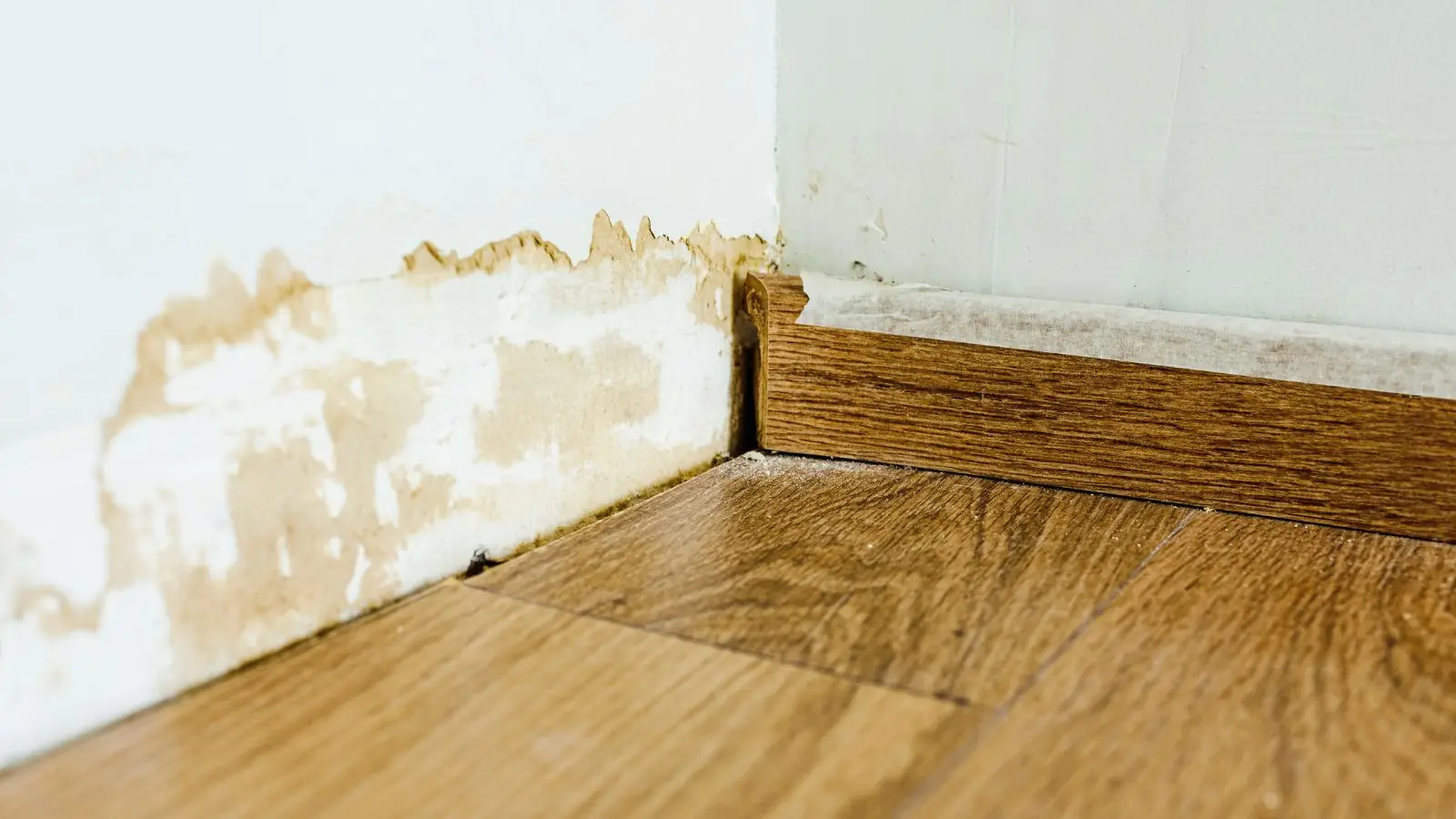
Why the signs of water damage in walls are easy to miss
Most wall leaks start inside the cavity, between the drywall and the studs. Supply lines, drain lines, window flashing and appliance hookups all run through that space, so a slow drip can wet insulation and paper for weeks before anything shows on the paint. By the time you see it, the damage is usually bigger than the spot suggests.
The signs of water damage in walls fall into a few groups: what you see, what you feel, what you smell, and what only a meter can read. One clue alone can be a false alarm. Two or three together deserve action.
Stains, bubbling paint and texture changes
Yellow or brown stains are the classic sign. They often start as a faint tea-colored patch and grow a ring at the edge as the wall dries and gets wet again. A stain with a clear ring has probably been wet more than once.
Bubbling or peeling paint means moisture is pushing outward from behind the surface. Drywall that feels soft, crumbly or swollen at a seam is holding water in the paper. Wallpaper that lifts at the seams and baseboard paint that cracks along the floor line point the same way.
- Stains that grow after rain, showers or the dishwasher cycle
- Paint that blisters, flakes or feels damp to the back of your hand
- Drywall seams that ripple, bulge or show nail heads that have popped
- Wall texture that looks smoothed out or sagging in one patch
Warm spots, cool spots and the musty smell
Wet drywall conducts heat differently than dry drywall. A patch that feels cooler than the wall around it can mean cold supply water or evaporation is pulling heat out. A warm patch, especially near a water heater or along a hot line, can point to a leaking hot supply pipe.
A musty or earthy smell is the other big clue. It tends to be strongest when the room is closed up, and it can come from a wall you cannot see any damage on. Treat the smell as a reason to look, not as proof of anything specific.
Soft baseboards, warped trim and sticking doors
Press gently on the baseboard near corners, under windows and beside bathrooms. Wood or MDF that gives under your thumb, swells at the bottom or separates from the wall has been absorbing water. Door casings that swell and doors that suddenly stick can show the same thing, because wood trim takes on moisture quickly.
Floors give hints too. Cupped laminate or hardwood next to a wall often means water is traveling from the wall into the floor system.
| What you notice | What it may mean | Next step |
|---|---|---|
| Brown ring stain on a ceiling-wall corner | Roof, attic or upstairs plumbing leak | Mark the edge with pencil, check it in 24 hours, call if it grows |
| Bubbling paint near a bathroom | Moisture from a shower, supply or drain line | Stop using the fixture and have the wall read with a meter |
| Cool, damp patch on an exterior wall | Window flashing, siding or condensation issue | Look outside for gaps and book a moisture reading |
| Warm patch along a pipe run | Hot supply line leaking inside the wall | Shut off the water to that line and call for help |
| Soft baseboard and musty smell | Long-term slow leak or repeated wetting | Avoid opening the wall yourself and ask for an inspection |
Pencil test
Trace the outer edge of any stain with a pencil and write the date beside it. If the stain grows past the line a day or two later, the source is active and the wall is still getting wet.
How moisture meters and thermal imaging find hidden leaks
A pin or pinless moisture meter reads how wet the drywall, wood or plaster is, and a crew compares those numbers to a dry reference spot in the same room. That comparison matters because every house has its own baseline. A reading is only useful next to a known dry reading.
Thermal imaging cameras show surface temperature differences. Wet material often looks cooler or warmer than dry material around it, which helps a technician decide where to take meter readings. The camera does not see water directly, so a good crew confirms with a meter before opening anything.
Seeing stains, soft trim or a damp wall? Call (303) 952-8295 and a dispatcher will talk through what you see, explain the scope and price before work starts, and send a crew any hour of the day.
Call (303) 952-8295What a crew does once the leak is located
The first job is stopping the source. After that, wet insulation and drywall that cannot dry in place are typically cut out, and the cavity is opened enough for air to move through it. Drying equipment then runs for several days while readings are taken until the wall matches the dry reference.
That process is covered in our water mitigation work, and the rebuilding afterward falls under water damage repair. Crews following ANSI/IICRC S500, the published water damage standard, document readings so you can see the wall reaching dry. You can ask any company whether its crews work to that standard.
Littleton, CO: what the numbers say about your walls
NWS Boulder lists Denver's normal annual precipitation at 14.48 inches and normal seasonal snowfall at 49.0 inches, with western and southwestern Denver suburbs averaging roughly 65 to 70 inches of snow a season. These are metro area figures, not Littleton readings. The tie-back is simple: after a heavy snow season melts against exterior walls, check the base of those walls and window corners for new stains.
Census QuickFacts puts Littleton at an estimated 46,246 people in 20,449 households for 2025, with 61.2 percent of homes owner-occupied. Most households here own the walls they live behind, so a small habit helps: look at one wall in each room every month and press the baseboards.
Sources: NWS Boulder annual summary and seasonal snowfall pages, U.S. Census QuickFacts for Littleton city.
When it is time to call
Call right away if a stain keeps growing, a wall feels wet to the touch, or you can hear dripping inside a wall. Water damage often starts before mold, and the usual guidance is that mold can begin within 24 to 48 hours of wetting.
We also dispatch to southwest Denver and Englewood, so if a neighbor or relative nearby has similar clues, send them the same advice. Whatever the cause, ask your insurer how your policy treats sudden leaks and gradual leaks, because they are often handled differently.
Common questions
No. A small stain can sit on top of a wet cavity, and a large one can be old and dry. A moisture meter reading next to a dry reference tells you far more than the size of the mark.
It can be, but it can also come from a damp carpet, a basement or a closed closet. Look for a second clue such as a stain, soft trim or a cool patch, and if you find one, get the wall read.
It shows temperature differences on the surface, which suggest where water might be. A crew confirms with a moisture meter, and opening the wall is the last step, not the first.
Sudden and accidental leaks are often covered, and gradual leaks and neglect often are not. Flooding is usually excluded and needs separate flood coverage. Check your policy and ask your insurer.
Start where exterior walls meet the ground and around window corners, since melting snow collects there. Look for new stains, soft baseboards and paint that blisters, and check again after the next thaw. If you find something, call for a reading.