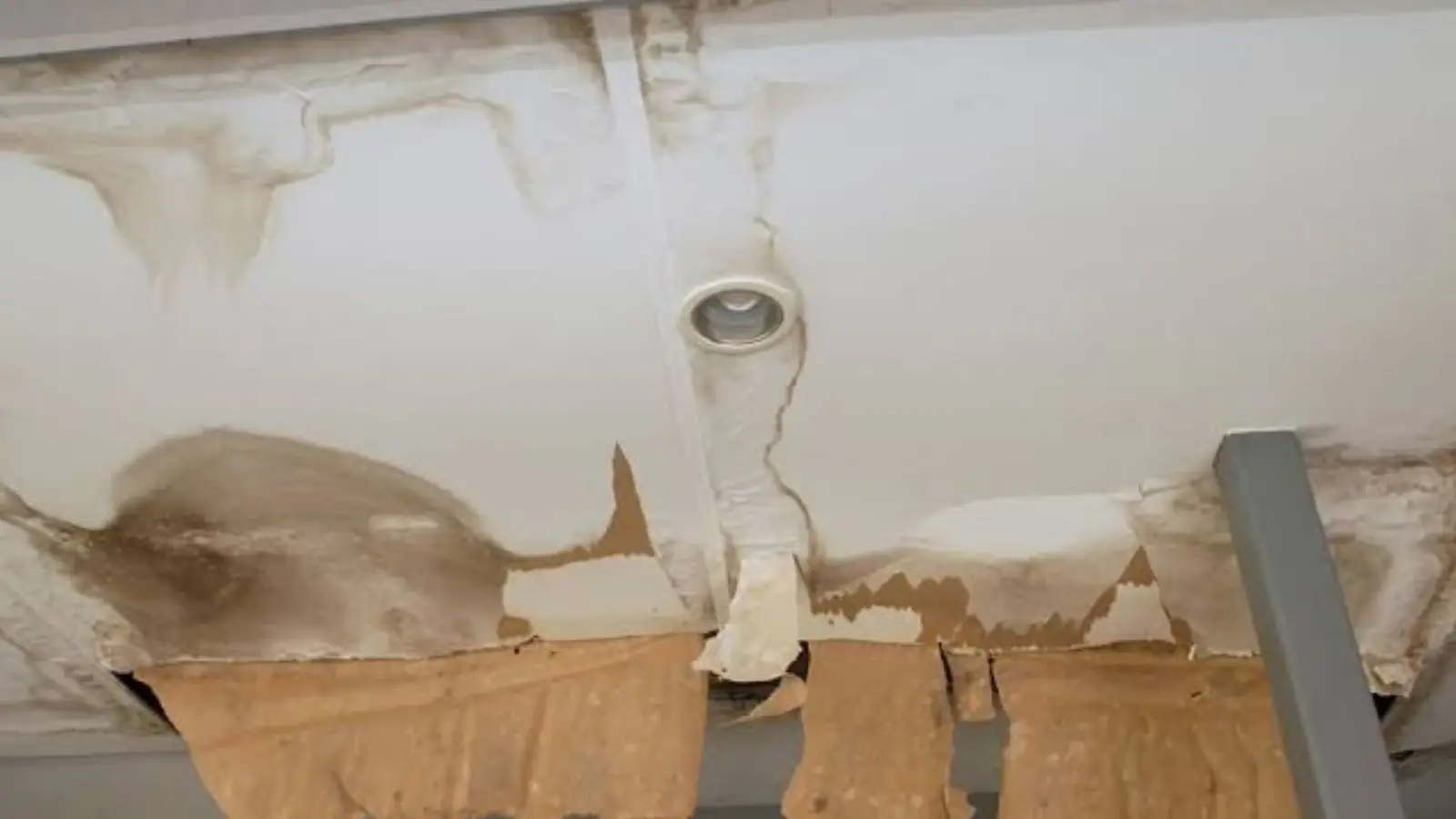
What a stained or sagging ceiling is telling you
You need to repair a water damaged ceiling in Littleton, CO only after you understand what water is doing up there. A yellow or brown ring means moisture has passed through the drywall, perhaps more than once. A bulge or sag means a pocket of water is sitting on top of the board.
Either one deserves quick attention. Wet drywall loses strength, and a heavy pocket can let go all at once.
Safety steps first: lights, power and weight
Stay out from under a bulging ceiling. If water is dripping from a light fixture or fan, turn off the breaker for that circuit before anyone touches the switch, and only when the breaker box is dry and reachable.
Move furniture and rugs away. Set buckets and a tarp under the drip and keep children and pets out of the room.
When and how to puncture and drain a bulge
A bulging ceiling holding water is safer to relieve on your terms than to leave. Put a bucket and plastic sheeting below, wear eye protection, and push a screwdriver through the lowest point of the bulge, standing to the side. Water will run out, and a second or third small hole may help it flow.
Do this only if the ceiling is still intact and you can stand clear. If the area is large, near wiring or the sag is heavy, step back and call for help instead.
Never puncture near a light fixture
Water pooled near a fixture or wiring is a shock risk. Cut power first, and if you are unsure whether the circuit is dead, do not poke the ceiling. Call a professional.
Find the leak, not just the stain
The stain sits below the leak but not always right under it. Water runs along joists and pipes before it drips. Look above and to the sides, and check the roof, the plumbing and the mechanical equipment.
A repair that ignores the source will fail. The ceiling will stain again, and the damp material above will keep growing mold.
| Source | Clue | Typical timing |
|---|---|---|
| Roof | Stain gets worse after rain or snowmelt | Intermittent |
| Upstairs bathroom | Stain below tub, toilet or shower | Often when fixtures are used |
| Supply pipe | Steady drip, wet insulation | Constant until shut off |
| HVAC condensate | Stain near air handler or drain line | Worse in cooling season |
| Plumbing vent or fixture seal | Slow ring that grows | Gradual |
A leaking upstairs tub drain, a cracked toilet supply or a clogged condensate line can all do this. Our emergency water removal crews can pull water and open the ceiling cavity while a plumber or roofer handles the cause.
Patch or replace: how to decide
A small, dry, firm stain on otherwise solid drywall can often be sealed with a stain-blocking primer and painted. If the board is soft, cracked, crumbly or sagging, it needs to come out. Drywall that has been soaked and dried once may still hold, but board that stayed wet for days usually does not.
Insulation above a wet ceiling often needs replacement too, because wet insulation holds water against the board.
- Keep and paint: dry, firm board, faint stain, no sag, cause fixed.
- Patch a section: small soft area, board otherwise sound, cut back to the joist lines.
- Replace the panel: large sag, repeated wetting, dirty water or long exposure.
- Open it up: any sign of mold growth, wet insulation or an unknown source.
Ceiling sagging or dripping? Call (303) 952-8295 and a crew will be dispatched day or night.
Call (303) 952-8295Drying the cavity before closing it
Closing a wet ceiling traps moisture. Before new board goes up, the joist bay should read dry on a moisture meter. Air movers or a small drying setup may be needed for a few days.
Mold needs moisture to grow, and testing and remediation for it follow the S520 standard. Any health concern belongs with a physician.
The repair itself
The new board is screwed to the joists, taped and finished with joint compound, then textured to match. Primer goes on before paint, or the stain can bleed through. Popcorn and orange peel textures are the hardest to match.
If wiring or a bathroom fixture was involved, a permit may be needed for those parts. Our water damage repair team can handle the drywall and finish after the area is dry.
Keeping the next ceiling stain from happening
Look at the usual suspects twice a year. Check tub and shower caulk, toilet supply lines, the condensate drain on any attic or closet air handler and the roof flashing after a heavy storm. A small drip caught early costs a patch of paint instead of a ceiling.
If a stain reappears, mark its edge in pencil with the date. A ring that keeps growing is an active leak, and a ring that stays put may be old. Either way, a moisture meter reading tells you more than your eyes do.
Littleton, CO: where your water comes from and how to stop it
Denver Water supplies Littleton residents, according to the City of Littleton Utilities page. Denver Water's cold weather tips say the main shut-off valve in most single-family homes is in the basement or crawl space, on a wall facing the street. If a supply pipe above your ceiling is leaking, find that valve now, before the next emergency, and make sure everyone in the house knows where it is.
Denver Water also advises shutting off water before thawing a frozen pipe and using a hair dryer, never a torch. A frozen pipe that bursts above a ceiling is a common way a stain turns into a collapse, so thaw slowly and keep the valve close at hand.
Sources: City of Littleton Utilities page, Denver Water cold weather tips.
Our crews also drive to Aurora and Morrison for ceiling and leak calls.
Common questions
If it is a contained bulge, away from lights and wiring, relieving it through a small hole over a bucket is safer than waiting. If it is large, near fixtures or you are unsure about power, stay out and call a professional.
Only if the board is dry, firm and the leak is fixed. Use a stain-blocking primer first. Painting over a still-wet ceiling hides a problem that will return.
Soft, crumbly, cracked or sagging board, repeated wetting or dirty water are all signs it should come out. Firm, dry board with a faint ring may only need primer and paint.
Sudden and accidental water damage is often covered, while gradual leaks and neglect often are not. Check your policy and ask your insurer, and take photos before anything is removed.
Check for a frozen or burst pipe and know where your main shut-off is. Denver Water says to shut off water before thawing a pipe and to use a hair dryer, never a torch.